Money and Global Risk

The World Economic Forum’s “Global Risks Report 2016” was published on January 14, 2016 with little media fanfare, but it addresses very serious global issues facing all nations over the next decade.

A review of 29 risks identified in the report reveals 9 of them to be directly associated with money while another 17 (or 90% of all risks) can be reasonably argued to be linked to money. If you needed evidence that money was rooted in many of humanity’s problems, then I cannot think of anything more compelling.

The report goes on to suggest that we should develop resilience in response to these issues, but I would suggest differently. If we did away with money entirely, then 90% of our problems would be resolved. To develop resilience would be to continue accepting money as a supporting framework for society, but I assert that this will only serve to perpetuate rather than solve these global problems.

Our reliance for millennia on money as a means to an end has brought us to the edge of environmental and societal precipices. Do we have to go over the edge to realize that there is a problem?

Given humanity’s nature not to be proactive, perhaps that is where we’re headed.

“This is hell … I want to be free”

These are a Venezuelan citizen’s words posted to the Comments section of a New York Times article entitled “Dying Infants and No Medicine: Inside Venezuela’s Failing Hospitals” (May 15, 2016).

This individual also said, “I going to protest again.Last time i almost die, the national guard shoot me,i run covered in blood.I escape. I don’t care if I die anymore.

What this Venezuelan was willing to die protesting against is a life we may all experience when our own markets collapse and we too are left to scavenge for basic supplies whose availability we currently take for granted.

The bulk of reader comments for that article pits socialism versus capitalism as the cause of and the cure for that country’s economic problems. In the end, however, if money had been removed from the picture decades ago this would not be Venezuela’s fate. The fact that the oil boom in that country created a lot of wealth but was not saved for future market downturns would not be an issue today had the boom been motivated simply by a demand for supply and not by promises of excessive profits for a small percentage of the population. In fact, the concept of a “boom” would not exist in a money-free world … Period. 

As one other reader commented, “In reality, this is a tale of greed and corruption. The current situation in Venezuela is the result of years of squandered and stolen funds from the country’s sole export, oil, which has now seen prices collapse globally. This is what happens when billions of dollars are diverted to enrich cronies …

I could not agree more. Greed and corruption will always be money’s undesirable bedfellows.

Rather than trying to find a way to eliminate them, I would suggest that it’s time to show money the door and ask that its bedfellows leave with it.

An honest day’s work

A May 2016 New York Times article about the state of the workplace in France is a good (if not exaggerated) example why associating work with wages has always been a bad idea.

According to the article, the French have been operating under a labor system that essentially guarantees workers a job for life by means of a permanent contract even if their employer is struggling to stay in business in a down economy.

If the worker’s job performance is sub-par, then the employer will find it difficult to fire him because of this contract (referred to as a “contrat à durée indéterminée” or C.D.I.). Rather than endure a labor battle where the law favors the employee, the boss will take the easier path of hiring someone to replace him while leaving the poor performer to languish in the hallways with no purpose at the company other than to collect a pay check.

This same article quotes Étienne Wasmer, a labor economist, as saying that “(b)asic facts of economic science are completely dismissed.

Still, Mr. Wasmer’s statement highlights the relationship of having to be paid for one’s effort. Why can’t we just do the work because it needs to get done and not count on some form of external compensation for it? Why do we think that the payment of wages is the only form of motivation to make someone want to work?

Humans don’t consistently respond by being more productive for more pay. That’s not what motivates us. In fact, greater incentives can actually lead to worse performance!

The only job where people actually perform best is when you pay them just enough to take the issue of money off the table. After that, more money doesn’t do much to motivate workers.

What does this mean? I believe that paying people enough to take the issue of money off the table means they don’t need to worry about their hierarchy of needs. I can speak from experience that not being paid enough to meet the monthly demands of feeding myself, paying creditors and utility companies, covering commuting costs, etc. interferes with my ability to work. If I felt that I was paid enough, I could focus on my job and perform at my best.

Now just imagine if money didn’t even have to factor into the work one has chosen to do.

What if you knew that your hierarchy of needs was taken care of? What if you didn’t have to beg your boss for a raise? What if you didn’t need to prove yourself “worthy” of a pay increase?

I think you would actually get an honest day’s work done.
“Money doesn’t exist in the 24th century”

Even Gene Roddenberry, the originator of the Star Trek franchise and a true forward thinker, foresaw a future without money!

To elaborate, I came across a Star Trek movie from 1996 with a scene that astonished me. It was a discussion between Captain Luc Picard of the Federation starship “Enterprise” and a visitor to the ship from 21st century Earth.

She was asking how much it cost to build the ship and Picard answered, “The economics of the future is somewhat different. You see, money doesn’t exist in the 24th century … The acquisition of wealth is no longer the driving force in our lives. We work to better ourselves and the rest of Humanity.

Where have you read this before? <nudge, nudge, wink, wink>

I did some research on that scene and learned that from the earliest days of the original Star Trek television series, Mr. Roddenberry made it very clear to his writing staff that “money most emphatically did NOT exist in the Federation, nor did ‘credits’ and that was that.

However, some inconsistent references to money in the various movies and shows from the Star Trek franchise had cropped up over the years perhaps because some writers found it hard to avoid common money-related expressions to creep into the dialogue. With the “reboot” of the Star Trek motion picture series by JJ Abrams, money apparently had existed in the alternate reality examined by his movies. This suggests that there will always be a tension between those of us who want to do away with money entirely and those who can’t because they don’t want to lose the power that monetary wealth provides.

In the end, it all comes down to which side makes the most convincing argument for money’s usefulness to improve life on this planet.

From my perspective, I’m not “betting” on money to fix this planet’s many ills. It has consistently been on the losing side of history.

Living Lean

(Warning: Sarcasm ahead)

This is really living!

More days in the month than money left in your bank account with the added bonus that there are still more bills to pay. What fun! What bliss!!

Give up thoughts of going out to dinner or catching that movie. Forget about replacing your old phone or appliance because you can’t afford to do that right now. Maybe in 6 months? We’ll see.

Doesn’t it feel great? Don’t you feel your soul and dreams expanding?

What? “Shrinking, not expanding,” you say?

But isn’t this the way we are supposed to live? From pay check to pay check, living on credit, and “robbing Peter to pay Paul“?

Cutting back expenses until you are living leaner than lean … Honestly, that’s the only way to live!

Seriously, that’s the only way most of humanity has lived from generation to generation. Only a small fraction of the world population has enjoyed “the perks” while looking down on their fellow citizens with pity and not understanding why they choose to live so bare-to-the-bone or why they can’t work harder.

Those “unfortunate few” have options that everyone else can only hope for. It just doesn’t seem fair that their view of the lives of the downtrodden should be blocked by their piles of cash.

Ah, money: It so levels the playing field, doesn’t it?

It most certainly does not. 

The Power of Zero

Imagine taking all the monetary value in the world and multiplying it by zero.

What’s left behind?

Everything except money.

All infrastructure, goods and services would remain because these items are not dependent on the existence of money. Of course, the knee-jerk reaction would be to say that these things exist precisely because of money since they would not be possible without cash “lubricating the gears” of industry.

However, this reflex reaction is born from the paradigm that money (read: profit) always was and always will be what drives and motivates everything from digging the raw materials from the ground to producing the finished product to delivering it to your local store to paying the employee who sells it to you.

At least, that’s one way to look at it.

What if you were to take that same scenario, but remove the profit motive and replace it with a new one? For example, the motive to have whatever you need without cash determining whether those raw materials can be extracted from the ground, finished and shipped to your local store.

Can you imagine how your life would be if we had a world exactly as it is right now where the gears of industry would continue to turn but without money involved at any step of the way?

Weird. I know.

However, every new idea takes time to be adopted and adjusted to. This one is no different.

A journey of a thousand miles begins with the first step.

Friction

Money has always hindered progress.

Any advancement made to systems or processes has been with the intention of saving money in order to boost profits, prevent cost overruns or reward shareholders. Also, any new technology that threatens to make an oligopolistic industry (e.g., Oil and Gas, the Auto Industry, etc.) obsolete and to wipe out its cartel’s massive wealth will be resisted.

True, unrestrained social and technological progress will not be possible as long as profits and budgets dictate which innovative ideas are adopted or dropped.

Ultimately, we are allowing the fate of humanity to rest on the backs of accountants and bureaucrats as they tell us that there isn’t enough money to pay for continued research into renewable energy sources, for pollution control, for investment in social support programs, for maintenance of infrastructure, etc.

Clearly, what money primarily does is add friction to social and technological advancement.

We can’t collectively progress forward as long as money dictates “how far along” we can move.

Sigh.

So all we can do is hobble forward because it’s the only rate of progress we can manage for now.

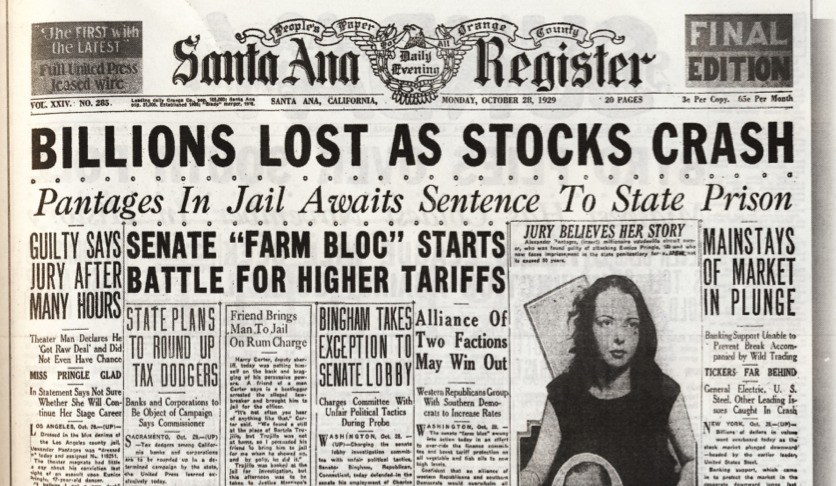
“Billions Lost As Stocks Crash”

That was the headline from the Santa Ana “Daily Evening” Register on Monday, October 28, 1929.

Ibillionslostf the world markets crash next week, the headline would likely read: “Trillions lost …

How would you react to reading or hearing something like that?

Would you throw up your hands and say that there is nothing to be done?

Would you passively watch your standard of living drop to a level you’ve never known before? Would you accept that this situation must be endured until the markets recover even if it may take what’s left of your lifetime?

Would you think that there is no other option?

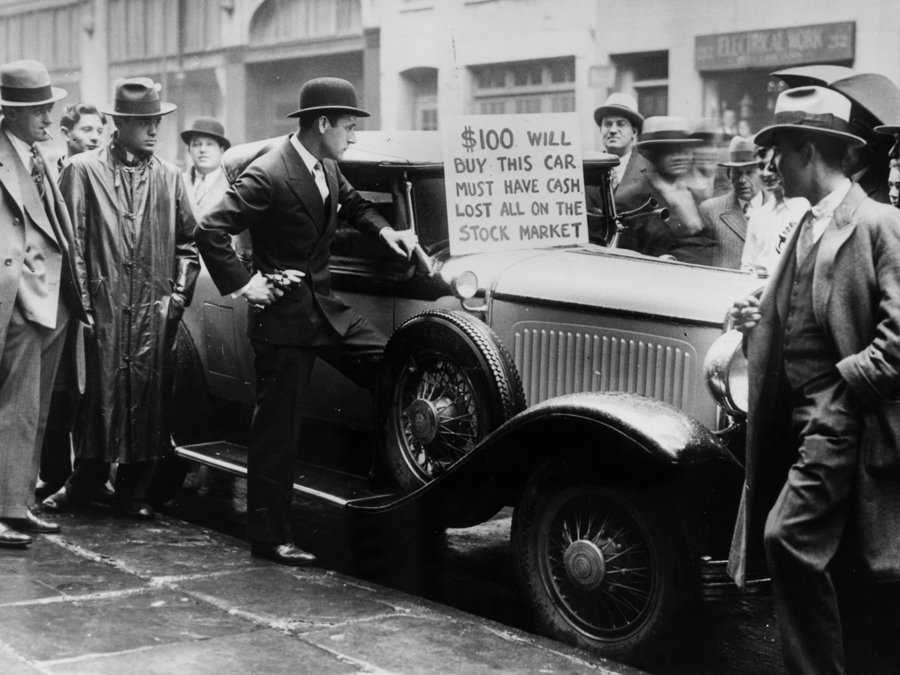
100dollarcarThis is the whole point of the blog: To ask the uncomfortable questions and to remind us that we have a very real option to reject the artificial limitations that money imposes on humanity.
We have a rare moment of self-awareness to prevent a worldwide economic depression by collectively agreeing that the “economic” element is unnecessary. Money markets exist on the assumption that our welfare is tied to their health.

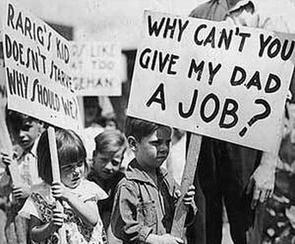
givedadjobIf we took a leap of faith by trusting we can survive with the systems that already deliver objects of consumption through existing distribution channels without the need for money exchanging hands, then humanity will have taken a collective evolutionary leap.

The catch is that we need to make that leap before the next “Crash” happens.

To not do so means we deserve what’s coming.

I trust the majority agrees that we don’t.

You can’t take it with you

If dying means leaving it all behind, then what is the point of accumulating wealth?

These days — warning, sarcasm ahead — the point is usually so that the heirs and relatives of the deceased can fight over the estate.

Sarcasm aside, if we lived in a money-free society, then there would be no interest in someone’s accumulated wealth because there would have been no money to be saved. Furthermore, there would be no desire for their belongings since material goods would already be freely available to all.

In other words, nobody would want what the deceased once owned because they would likely already own it themselves.

In a money-free society, your heirs and relatives would sincerely mourn your passing rather than covet your property.

That is the only way to celebrate a life well lived.

“Who doesn’t want to make a profit?”

Profit. noun | prof·it | \ˈprä-fət\ … the excess of returns over expenditure in a transaction or series of transactions; especially :  the excess of the selling price of goods over their cost

The “excess of returns” … the promise of a killing.

Everyone on the selling end of a business transaction seems to be motivated by the idea of getting much more than what they paid for to provide a product or service.

What about getting “nothing” for “something”?

Ask anyone that question today and most will answer: “Not me!

Why? If Merchant A gives away the product of her effort to Merchant B with no expectation of monetary payment (let alone a profit), nothing stops Merchant B from doing the same when Merchant C approaches him for his services. The transaction between merchants B and C perpetuates the need to continue using money as a medium of exchange which means that Merchant A loses in this current system and will not feel motivated to do the same next time.

For this “nothing for something” concept to work, everyone will need to agree that we can be consumers without needing to pay for whatever product or service we use.

More easily said than done.

However, there is a global awakening to the fact that the current system is broken and we need to fix it. Not all nations may agree to adopt a “nothing for something” system, but if it were supported by treaty — a true FREE Trade Agreement — with participating countries only trading with treaty partners and agreeing that human labor has no monetary value, then there is a good chance that critical mass can be achieved with the rest of the world coming on board when the remaining countries realize that many global conflicts can be resolved because at their heart is the promise of an “excess of returns.

Truly, no more need for killing in the name of profits.