Death and Taxes

Nothing is more certain than death and taxes!

This statement resonates with a lot of people simply because it’s true. There are few places in the world where taxes on income or goods are very low or non-existent.

Wealthy individuals hire accountants and corporations have departments dedicated to solving how they can pay the fewest taxes to their local, state and federal  governments.

Unfortunately, not-so-wealthy private individuals are not so fortunate and see a good portion of their hard-earned wages taken to fill government treasuries. Too often, their involuntary “contribution” increases from year to year.
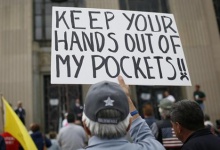
handsoutofpocketsOne does not have to be a genius to see that excessive sales and income taxes drive down personal spending and both create a negative impact on consumer purchases. This weakened demand results in manufacturing sector layoffs which then put a burden on governments to pay unemployment compensation (UC) benefits which then oblige governments to raise taxes to be paid by the remaining workers to cover the increased demands on UC funding which only then aggravate the already negative impact on the demand for goods. Sounds like a downward spiral, doesn’t it? However, this happens all the time. What insanity.

It seems like the only way to properly eliminate taxes is to go to the source of the problem by eliminating money itself.

Without money, government treasuries would not need to be kept filled through the imposition of a levy. Governments, like people, would be free to make use of any product or service with no expectation of payment in return, so they would not have to charge taxes (i.e., raise money) to pay for their consumption.

Everyone could then consume what they wanted — when they needed it. They would not have to worry about passing up on a product or service saying that it was something they “can’t afford this month.”

It is my hope that future generations will instead be heard to say that “Nothing is more certain than the death of taxes!

Now wouldn’t that make for a nice change?
The root of all evil …

For the love of money is the root of all evil: which while some coveted after, they have erred from the faith, and pierced themselves through with many sorrows.” (1 Timothy 6:10, King James Version)

This oft-quoted first century biblical verse demonstrates that money has been around for a very long time. In fact, a reference in Ecclesiastes 5:10 documents that human civilizations had struggled with the use of money about four centuries before that!

Although these texts are drawn from Judaic and Christian sources, all of humanity – regardless of faith tradition – has suffered for its use of money … and nearly 25 centuries later we still do.

Most of us have seen the good that money can do, but humanity has too often shown its dark side in its pursuit of accumulating it.

So why – in spite of the overwhelming evidence that money brings out the worst in human nature – do we continue to use it as a means to trade goods and services? Pound for pound, more harm than good has come to humanity in the name of money, but we still insist on basing our daily existence around it.

I suspect that we continue to use money more out of habit for the very simple reason that it is all we know in spite of the harm it continues to cause. This “habit” was likely established in a time predating recorded history when humans created barter-based economies, i.e., trading services and goods for the other without the use of money. This long-standing habit will be hard to break, but it needs to be broken because as far as bad habits go, it’s about the worst there is.

bad-habitsExperience shows that people do not like to change what’s familiar even when a familiar routine does not benefit us and it is especially true regarding our use of money. Of course, many of you are thinking: If we stop using money, what will replace it?

That is a good question.

Ultimately, why does anything need to replace it? Why can’t we just continue putting food on the table and keeping a roof over our heads while continuing to produce goods and offer services as we always have without having to demand or offer payment for those transactions? The infrastructures already exist to allow the free flow of goods; just eliminate the friction that money imposes on this flow to truly make it free in order to allow ALL of humanity to truly be and to truly exist.

It may seem like a “pie in the sky” idea, but humanity needs to give up thinking that money needs to be a part of who we are and what we do. We need to see money as the root of the majority of our problems in the world and decide that we can’t keep living this way anymore.

It may be too optimistic to think that we can eliminate our reliance on money within a generation, but the hope is that the problem is too self-evident to continue pretending that it doesn’t exist.

The value of human effort

A July 2015 article from a business news site highlights the centuries-old argument about the value of one’s job title and monetary compensation.

According to that article, American business owner Dan Price had announced in April 2015 that he was raising the minimum salary of his employees to $70,000 a year (by slashing his own million-dollar pay package) with the result that 25% of his employees would see their salaries double. Overnight, Mr. Price had become something of a folk hero.

Quite understandably, those 25% were very happy. Who wouldn’t be?

It turns out that a few were not.

Two of Mr. Price’s most valued employees quit because they thought it unfair to double the pay of some new hires while the longest-serving staff members got small or no raises.

In his defense, Mr. Price’s stated that he wanted to fight for the idea that if someone is intelligent, hard-working and does a good job, then they are entitled to a middle-class lifestyle.

So, which group is right? Those who think that they should be paid what they are worth based on their years of contribution and job complexity or those who believe that they should be paid enough to meet their monthly expenses and still have enough set aside to put into, say, their children’s college tuition savings or their own retirement?

In other words, should a specific “wage value” be placed on human contribution based on the type of work they do?

The real question is: Does it really matter?

Why can’t we all make a contribution to maintaining our society without the payment of a wage? Of course, this assumes that we don’t need a wage to address our monthly or long-term expenses because the idea of “expenses” would no longer apply in a cash-free world.

Furthermore, the removal of a wage concept would eliminate the segregation of society into lower, middle and upper classes because we wouldn’t categorize ourselves based on how much we earned at a job.

Something to think about.

Insanity

I have heard it said more than a few times that insanity can be defined as doing the same thing over and over again, but expecting different results.

For instance, how we think of money.

The monetary system has been around in various forms for roughly 5000 years and has impacted human societies to this day.

However, it’s a system that’s flawed, especially if you look at how it has developed into a currency-based exchange. Some would say that currency itself is not real money and that precious metals like gold and silver are the true monetary standard. They would have you think that markets based on such metals would create a more stable economic system.

Perhaps, but a disproportionate few would still accumulate the majority of the gold and silver, and therefore have all the power because “he/she with the most gold wins.

On the flip side, the majority of people would once again find themselves powerless because they don’t have enough wealth to invest in either gold or silver and must instead choose to spend what few euros, pesos, dollars or rubles they had to feed their children or themselves and keep a roof over their heads.

So how does the above definition of insanity apply to money?

What we appear to be doing “over and over again” is believing that trading goods and services in exchange for money that, in turn, is used to buy other goods or services is a system that works.

At first glance, it seems fair: We trade our money for goods and services based on a given price. Depending on how wisely we spend it, we may have some money left by the end of the day. At some point, however, we’re going to run out (but may have a shed full of “stuff” to show for it).

Of course, there’s tax to pay on that stuff and if we want to sell some of it to get some of our money back, we generally do so at a loss. This type of “friction” is built into the monetary system where “money in” does not equal “money out”; much of it gets lost to different beneficiaries along the way.

It’s a system that’s broken, but we keep thinking that “one day” we will fix it and so continue to use money to buy, invest, speculate, save, etc., while we watch a handful of individuals accumulate vast amounts of cash and manipulate the markets (until they crash) because they know how to use this friction to their advantage while the majority of humanity lives in squalor or simply exists with no hope of a better life.

So the cycle repeats itself over time while we cling to the belief that, one day, things will be different.

Pure insanity.

If we can all agree that it’s a system that’s broken, then why can’t we also agree to try something different?

What if we took money out of that exchange altogether?

What if we could freely give or take goods and services with no expectation of compensation of any kind (and no taxes to pay)? I would call that a frictionless system.

Why must we always think that we need to get “something” for “something else?

What about “something for nothing?

Imagine

“… Imagine no possessions
I wonder if you can
No need for greed or hunger
A brotherhood of man
Imagine all the people
Sharing all the world

“You may say I’m a dreamer
But I’m not the only one
I hope someday you’ll join us
And the world will live as one

When John Lennon penned those lyrics in the early 1970’s, he had a vision of a non-religious, non-nationalistic, non-conventional, and non-capitalistic world. Lennon said that he was not the only one and he was right; I counted myself among those convinced that his vision could one day come to pass.

Over the last 40 years, his song — “Imagine” — has become universally-recognized by millions of people as an anthem for peace as well as a counter-culture statement which highlights the still-current issues of political and religious tribalism, warfare, and material ownership.

Can we live without possessions? Can there no longer be greed or hunger?

It’s hard to say.

Many assume that we have lived with these issues for so long that they are a part of “who we are” in spite of race or culture. That most of us will never have enough “stuff” (or, at worst, enough to eat) will continue to be our inheritance from previous generations unless we make a decision to change that.

A decision to change: That is the whole point.

Why should we accept that things will remain the same just because that is how things have been done for centuries? That way of thinking has not helped humanity make any quantum leaps forward.

I firmly believe that even centuries-old habits can be changed and that it’s crucial we start NOW because, in my opinion, humanity is fast approaching a crossroad where staying in the same money-lined rut guarantees more misery for future generations, while taking a “hard left” ensures that we choose a new path for ourselves — as a world community — which requires a new way of thinking.

Imagine that.

Graveyards are the richest places on earth

I need to share this message with you:

Money is just an idea and not a permanent concept.

People need to understand that we agree to use money as a way to manage transactions, but we all know — deep down — that it is a flawed system and we must come up with a new idea before the old one destroys us.

However, I have a limited number of days on this Earth before my message is lost to time if I don’t share it with the world. I don’t want to risk taking the message to my grave and missing the chance to pass the torch to someone else who would carry it.

As Les Brown said, the graveyard is the richest place on earth because “it is here that you will find … the books that were never written, the songs that were never sung, the inventions that were never shared, the cures that were never discovered, all because someone was too afraid to take that first step.”

I am taking that first step.

Humanity’s wake-up call

My sense of living was much lower than my sense of self-respect and pride, the fact that I had lost my right to be … free …

That was what a desperate and angry Apostolos Polyzonis recalls thinking before the 55-year-old Greek businessman spent his last 10 euros (US $12) in September 2011 to buy a gas can which he would use to douse himself in fuel and attempt to end his life in flames.

At that moment, I saw my life as worthless, I really didn’t care if I was going to live or die.”

What drove him to such utter desperation?

Money.

It was the same reason why, on April 4, 2012, retired pharmacist Dimitris Christoulas shot himself in the head in Syntagma Square during morning rush hour in Athens. In his suicide note, the 77-year old Christoulas stated that the government had made it impossible for him to survive and that he preferred to die than scavenge for food.

A translated extract from the note reads: “The collaborationist Tsolakoglou government has annihilated my ability  for my survival, which was based on a very dignified pension that I alone (without any state sponsoring) paid for 35 years. Since my advanced age does not allow me a way of a dynamic reaction … I see no other solution than this dignified end to my life, so I don’t find myself fishing through garbage cans for my sustenance…

The situation is becoming every day worse,” says Polyzonis. “Every day people lose their jobs, every day people are unable to pay rent for their house, the basics to find something to eat — the last step before doing what I did or what another human being (on Wednesday) did in Greece.”

You don’t have to be an economist to understand that we are on the verge of an unprecedented collapse of our global financial markets due to poor management of public and private finances. The crisis in Greece (and now Venezuela) is a preview of what we can expect will spread around the world and that will impact healthy and unhealthy economies alike because most nations are interdependently related in their ownership of another’s debt, their reliance on goods and services of one kind or another whose availability will dramatically plummet as stock exchanges crash into one another like giant dominoes, bringing production (and consumption) to a grinding halt. Those nations that survive their own market crash will be the target of the have-not countries who resort to warfare in order to secure basic supplies like food, clean water and fuel.

It seems so unreal, but quite likely if you dare to imagine events through to their logical end. “It’s happened before and it will happen again,” you may hear economists say.

But does it have to?

Why do we need to let money rule our lives this way? “That’s the way it’s always been,” may be your automatic reply.

So, again, I ask: Does it have to?

What other options do we have?

The only option that is staring us in the face if we had the courage to accept it: No money.

No cash. No market crash. No credit. No debt. No system based on the exchange of goods or services for another.

A true “free world.

A system based on the supply and demand of goods and services just because we need them to survive. Humanity providing for the needs of a fellow citizen, a neighboring country, an ecosystem in crisis … all at no cost … with no expectation for repayment … ever.

No more homeless. No more prostitutes. No more daycare. No more drug wars. No more mafia. No more raping of the planet’s natural resources in the name of consumerism. No more banks. No more 99% vs the 1%. No more taxes!

No social classes based on monetary wealth. No more haves and have-nots.

Only this: A right to having the free and unrestricted use of all the things which may be necessary to your fullest mental, spiritual and physical unfoldment … without having to be rich.

What a refreshing concept!